Spiritual wealth grower doing it God’s way
Â
1st of 3 free financial workshops at Saint Sabina
Â
By Chinta Strausberg
Â
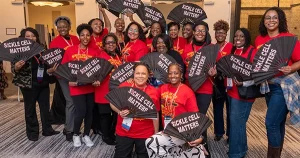
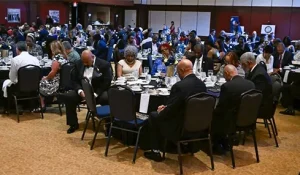
Hundreds came out late to hear Minister Deena Marie Carr, who teaches Finance: According To Your Faith (FATYF), present the first of three free financial workshops at Saint Sabina Church late Tuesday night that are bible-based and where she told the class, “God’s not broke. You shouldn’t be, either.â€
Carr, who blends modern business and financial strategies with biblical principles, provides her class with invaluable information and the tools they need to manage their finances.
Father Michael L. Pfleger introduced Carr saying she is a product of the Chicago Public Schools. Carr graduated from Whitney M. Young College Preparatory High School. She earned her Bachelor’s degree in economics from Northwestern University; a MBA in finance from the University of Chicago is the recipient of a Doctor of Philosophy degree in Ministry and Finance from Hope Bible School and Seminary. She continues her education at the London School of Economics where she is enrolled in the Executive Program.
Carr is a partner at a major management-consulting firm and she specializes in helping the leadership of Fortune 500 Financial Services and Insurance companies develop “cutting edge business strategies that incorporate the strategic use of technology to reach their goals.â€
Though she has adopted a son, she still finds time for her ministerial duties at the Christian Heritage Training Center, which is her home church. A “PK Kid,†Carr’s great-grandfather was a Baptist preacher; however, she was raised in the Pentecostal religion, and she uses biblical passages as the basis of her popular financial freedom classes.
Growing up as a child of a pastor, Carr said back then when you wanted something or money to pay your bills, you simply prayed for God to intervene and grant your wishes, but then she began to study economics, began working and consulting with businesses. That is when she learned that all the answers to financing are in the bible.
During her first workshop at Saint Sabina, Carr focused on “How do we structure our finances so that we are online in our financial lives the same way we are online with our spiritual lives with the word of God.â€
“The believer and their finances first operate on a spiritual context…. We believe that the spirit of God is solvent. We must understand the economic context, the economic environment that is going on and how†your plan works in that environment. “If you don’t get that right, you’ll mess up everything,†she said pointing to the unpredictable real estate field as an example. “Real estate is a fantastic investment in the right economic environment. If you do it in a wrong economic investment, you’ll lose your shirt.â€
Carr asked the class what metaphor is used when money is referenced in the bible. The answer is a seed. Asking for one of the students to pass her a bill, Carr held up a $5.00 bill. She told of how different people may spent that money like busying shoes that are on sale, a video, or a large screen TV almost as large as an apartment. But others are more responsible like spending their seed on gas. The question she asks was ‘what did you do with your seed�
She asked how do go about gathering your seed and how do you manage your seed. How you grow your seed is key to maximizing your return for taking on a prudent risk. She spoke about leverage, which is debt.
“Debt is only used to acquire an asset,†Carr said. “An asset is something that increases in value and preferably produces an income. If you use debt to acquire something that is not producing value and is not producing income, you are misusing debt,†said Carr.
Too often, people use debt to acquire things that decrease in value. Debt is a financial instrument that is used to acquire an asset. That is the only way to use debt, she said. Debt is a tool for deal making.
 “If you are going to start a business and you need $250,000 to start that business, there are two ways to do that. You can either give me ownership in the business…or borrow the money from a bank and keep your business….†“Debt is a tool for deal-making. It is not the way to finance your way of life.â€
The spiritual framework of her first workshop involve six steps:Â 1) spiritual context, 2) Economic context, 3) gathering seeds, 4) managing seeds, 5) growing seeds and 6) leverage which is debt which is only used to acquire an asset.
“An asset is something that increases in value and produces an income. If you use debt to acquire something that does not acquire income, you are misusing debt,†she warned. “Debt is a tool for deal-making. It is not the way to finance your way of life.â€
“The financial decisions that you make have to have prayer and they have to align before God,†said Carr. “We must tap into the wealth He has created by obeying every rule that He makes. God will speak to you and tell you exactly what to do…. The more you tap into the wealth that God created for us and the more you tap into it by obeying the word of God and taking actions in our lives, the more wealth flows through us,†Carr stated.
Spiritual obedience is the key to building wealth, she said. “We must tap into the wealth He has created by obeying. God will speak to you and tell you exactly what to do. The more we tap into it, the more the it will flow through us.â€
“God will take care of us,†Carr said. “We have to take our minds out of this notion of our money and our job are taking care of us. Our money and our jobs are not taking care of us…. You obey God and that job is your place of ministry to be your vessel to help that job, that company to walk the halls praying because God put you there for such a time as this to help Him in exchange for giving you some income, but they are not the source of the income. It’s what God is using at that time.
“And if they (your employer) get out of line and God tells me to leave, He is going to give me another source,†said Carr. She stresses that people should give to the Kingdom of God “because God is taking care of us.â€
Carr emphasized that “God is our source and these (jobs) are just vehicles and conduits that God is using to challenge us…â€to minister and to be the light and your salt and to be your revelation as what you should do in that situation….â€
She urged them to understand that they are to tap into their wealth that God has already created and to be obedient to God. “He says I give you the power to get wealth. He said you’re going to have gold…lots of things,†Carr said referring them to Deuteronomy 8:6-20. *
After reading these verses, Carr talked about giving and the importance of tithing. She asks the class to refer to the Old Testament as the Covenant. “It was the Covenant that God made with us. And the Old Testament is to be referred to as the “fulfillment of Covenant. “There is only one covenant. Jesus said I am not come to destroy the law. I come to fulfill the law.â€
On giving, Carr said, “Many people don’t give…. That covenant was given. Those things they were told to do that was something that God was telling them to do so that they could be his covenant people…..â€
“What is more important is that you give out of Covenant which means you give out of obedience. The first step of applying our finances is through covenant debate.
“How do we as believers build up wealth? How we structure our finances so that we are aligned in our financial lives the same way we are aligned in our spiritual lives with the word�
“People will tell you go right down all of your bills and write down how much money you got. That is a lot of effort to tell you what you already know. You have more bills than you have money. Stop spending so much money. That’s commonsense,†she told the class. “God’s not broke. You shouldn’t be either,†she said.
“How do we structure your finances to allow us to be successful and how do we take that to the next level whether you are working on a job or business?â€
She talked about tithes, offering, budgeting or financial structuring and debt management and the importance of the return on your investment and how it is the reward for having taking a prudent risk. However, Carr warned, “You have to make sure that the return matches the amount of risk that you take.â€
How does one deal with financial mistakes? Carr gave this advice: “It depends on where you are in a situation.†Carr’s main theme in wealth building is to always remember that “God is the one who gives the power to attain wealth†and that the bible is clear in saying God “is the one who gives you the power to get wealth.â€
In her book, “Wealth-Grow It God’s Way,†Carr warns “No matter what our level of wealth, we have a responsibility to manage it to the best of our ability and to increase it.â€
She asked the class what is the purpose of the tithes. Shrugging off incorrect answers such as tithes are for the preacher, she said, “The tithe was to take care of the Levites.â€
Referring to the 12 tribes, Carr, who also teaches a graduate course at North Park University, said, “It was the responsibility of the Levites to take care of the needs of the people. The tithe was a provision for the Levites….â€
The offering is for the priest. She also talked about the first fruit where God was asked to bless the rest of the harvest. “If you want God to bless you, if you want to tap into wealth, you have to look at wealth as something that you are creating but something that God is unleashing. What ever you get, you must first give back to God with the understanding that you are asking God to bless the rest of it.â€
“Giving becomes the mechanism that we physically demonstrate how God is first. If we cannot trust God we begin with a portion, then you cannot ask God to bless the rest. The more money you make, the more God tells you to give,†she said. “
“Our finances are not a separate entity from our spiritual lives but an intrical part, done as an instrument, not a way of life.†In her book, “Wealth – Grow It God’s Way: Financial Empowerment For Your Future,†Carr, who used to pray for a winning Lottery ticket, quotes from Proverbs 13:11 and the dangers of wealth quickly won.
Citing the many horror stories of those who do win huge amounts of Lottery prizes, Carr wrote this is not the type of wealth she teaches but rather “the wealth that is actually sustaining, that produces an income, allows us to live a life that is exciting and fulfilled, and, most important, allows us to extend the Kingdom of God.
“Think about it again. Does God want us to be wealthy? The answer is Yes, God does want us to be wealthy, but it is not the Lottery winning, riverboat gambling, or overnight riches that we focus on. The Lord is specific about wealth. He defines it, gives His children the ability to acquire it, and presents specific instructions on how to manage it,†she wrote.
What is the purpose of wealth? Car writes in her book, “The real question is: what are we growing our money for? We must tap into the fact that the purpose of our wealth is not just so we can be comfortable in this life. The bible tells us, “You ask and do not receive, because you ask amiss, that you may spend it on your pleasures†(James 4:3). The reason we increase wealth is so we can do more to make a difference in the Kingdom of God.â€
For those who go into business for themselves, Carr made it clear that they should not believe they achieved this goal on their own. Rather, she says “God wants us to remember that we have been blessed with businesses, as He promised in Deuteronomy, but when we develop these enterprises, we shouldn’t think we did it by ourselves. It was He who gave us the ability and power.â€
Wealth, she said, “does not begin in the natural; it begins in the spiritual†and the reason is that “wealth ultimately comes from and belongs to God. All you are doing is exercising your spiritual muscle to become one of His stewards.â€
Quoting from Matthew 9:37, Carr wrote in her book, “Jesus said, ‘The harvest truly is plentiful, but the laborers are few.’ I don’t think laborers exist just so we can all become preachers. I believe the Lord needs some individuals to have wealth because there are people in the world who are suffering, and these men, women and children need spiritual solutions, but they also need financial solutions.â€
She said God has given people enough power to be as prosperous as He has ordained in order for us to make a difference.
Jesus, she wrote, “emphasized that salvation was based on the heart of man, and our focus should be beyond the accumulation of wealth; it should be on building the Kingdom of God. It should be centered on doing all that we can to make a difference, and wealth, no matter how large or small, does not serve that purpose, it is of no use.â€
Carr gave the class a homework assignment: At her next free financial workshop at Saint Sabina, on Tuesday, April 24, 2012 at 7 p.m., she asked the class to write down these three things: 1) all of your expenses, 2) write down all of your sources of income including what you want your sources of income to be, 3) and beginning now, record all monies you spend including your debit or credit card or a newspaper.
Carr repeatedly told her students that God is their source of wealth. In her book, she wrote: “And God is able to make all grace abound to you, so that in all things at all times, having all that you need, you will abound in every good work….
“Now he who supplies seed to the sower and bread for food will also supply and increase your store of seed and will enlarge the harvest of your righteousness. You will be made rich in every way so that you can be generous on every occasion, and through us your generosity will result in thanksgiving to God (2 Corinthians 9:8, 10-11 NIV).
| The class was also asked to look up the scripture that tells them not to obsess about getting wealth.  One scripture, Proverbs 23:4 sums up her warning: “Do not wear yourself out to get rich; have the wisdom to show restraint.â€Â |
“Man runs out. Earth runs out. God never runs out. Thus, our Heavenly Father is not a resource, He is the source,†she wrote. If you want to generate an income, Carr asked, “wouldn’t it make sense to do that from the point of origin, from the Source� She emphasized that a person’s employment “is a resource†for their income and is “what God directs†you to do “in order to fulfill His will†in their lives and the life of the company where they work.
If you have more questions about, click on Carr’s website: http://www.financeaccordingtoyourfaith.org/
*6 “Therefore you shall keep the commandments of the Lord your God, to walk in His ways and to fear Him. 7 For the Lord your God is bringing you into a good land, a land of brooks of water, of fountains and springs, that flow out of valleys and hills; 8 a land of wheat and barley, of vines and fig trees and pomegranates, a land of olive oil and honey;
9Â a land in which you will eat bread without scarcity, in which you will lack nothing; a land whose stones are iron and out of whose hills you can dig copper. 10Â When you have eaten and are full, then you shall bless the Lord your God for the good land, which He has given you.
11 “Beware that you do not forget the Lord your God by not keeping His commandments, His judgments, and His statutes which I command you today, 12 lest—when you have eaten and are full, and have built beautiful houses and dwell in them;
Â
13 and when your herds and your flocks multiply, and your silver and your gold are multiplied, and all that you have is multiplied; 14 when your heart is lifted up, and you forget the Lord your God who brought you out of the land of Egypt, from the house of bondage; 15 who led you through that great and terrible wilderness, in which were fiery serpents and scorpions and thirsty land where there was no water; who brought water for you out of the flinty rock; 16 who fed you in the wilderness with manna, which your fathers did not know, that He might humble you and that He might test you, to do you good in the end— 17 then you say in your heart, ‘My power and the might of my hand have gained me this wealth.’
Â
18 “And you shall remember the Lord your God, for it is He who gives you power to get wealth, that He may establish His covenant which He swore to your fathers, as it is this day. 19 Then it shall be, if you by any means forget the Lord your God, and follow other gods, and serve them and worship them, I testify against you this day that you shall surely perish. 20 As the nations which the Lord destroys before you, so you shall perish, because you would not be obedient to the voice of the Lord your God.
Â
Chinta Strausberg is a Journalist of more than 33-years, a former political reporter and a current PCC Network talk show host. You can e-mail Strausberg at: Chintabernie@aol.com.